


Retatrutide
Triple-agonist peptide (GLP-1 - GIP - Glucagon) for preclinical metabolism research.
For research purposes only. Not for human or veterinary use.
COA & Quality
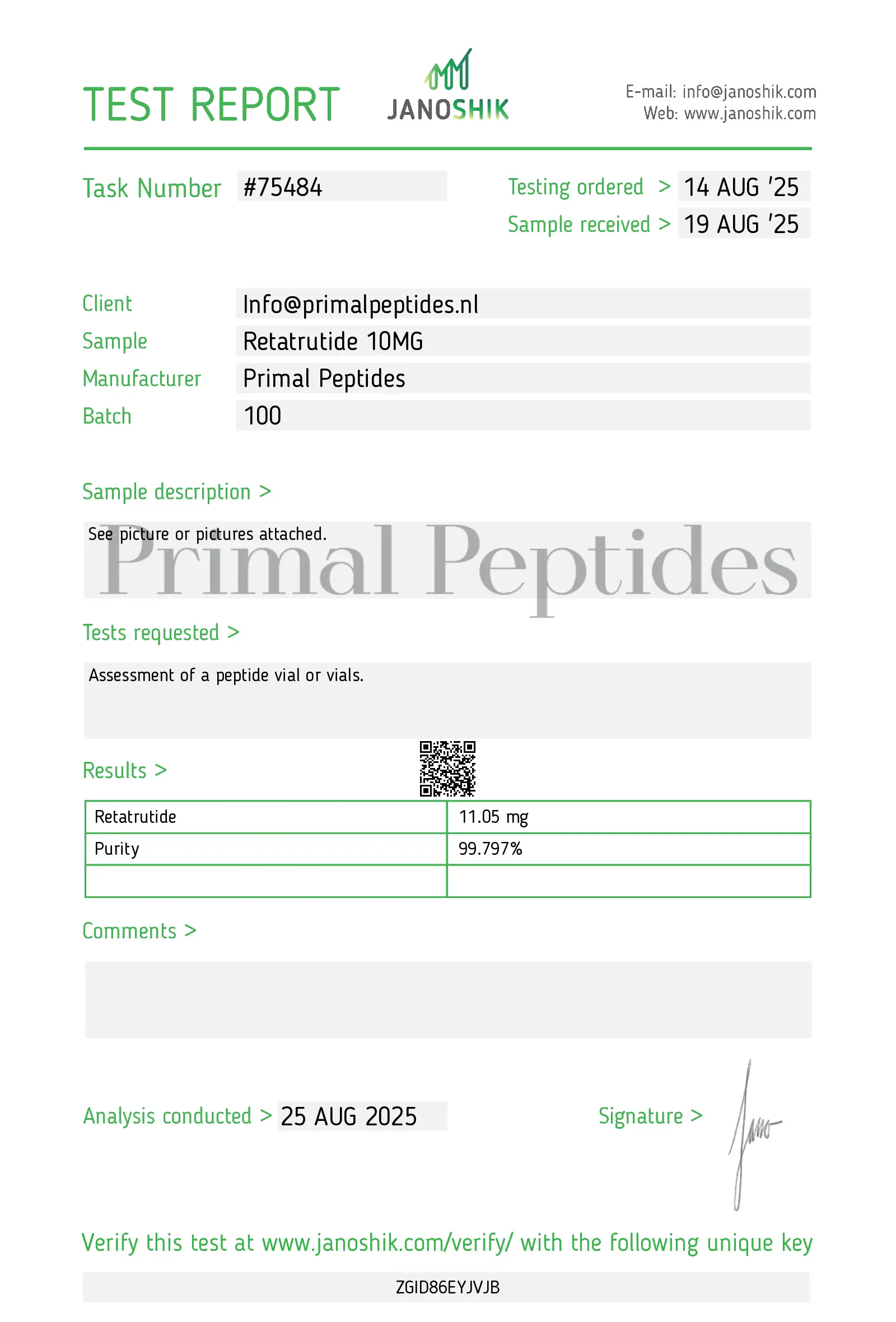
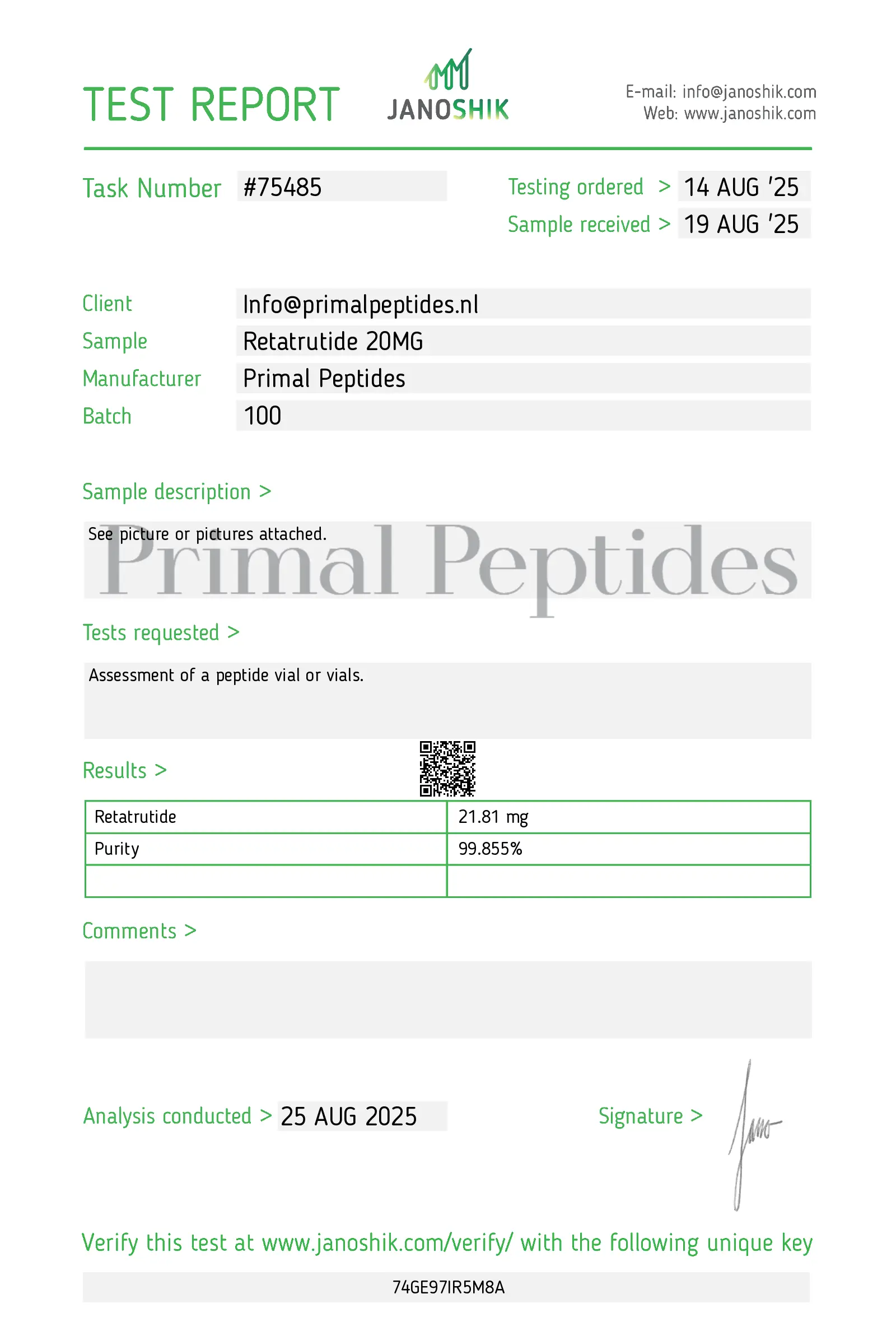
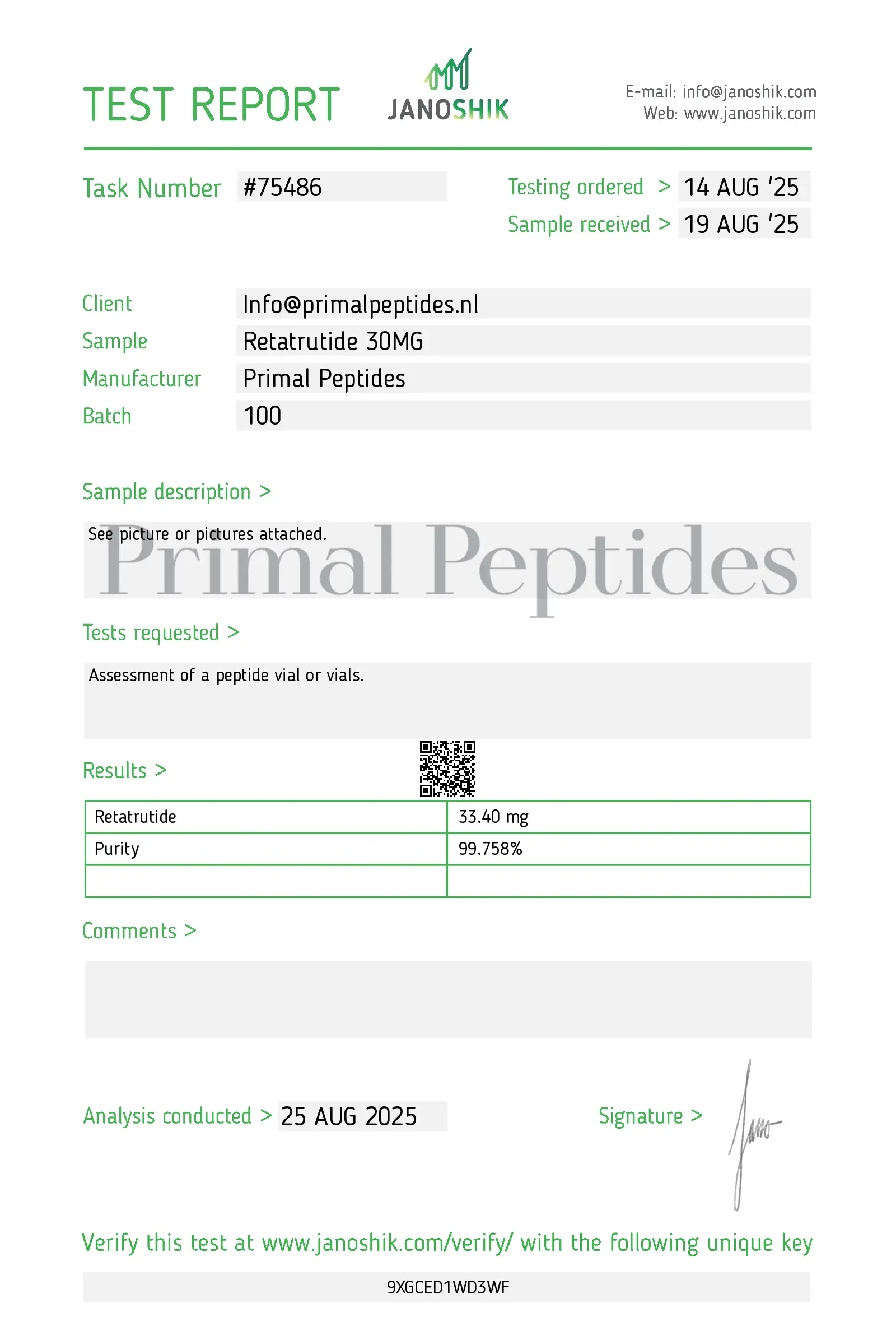
For each batch of Retatrutide, we provide a Certificate of Analysis (COA).. This document confirms identity and purity of the product. COAs are essential in research: they show what is in the vial, how pure it is and allow verification via a unique key at Janosik.com/verify.
Benefits according to research (preclinical)
The points below describe in research context (preclinical data and literature) What effects of a triple-agonist profile (GLP-1/GIP/Glucagon) are being investigated. These are no medical claims and are for research information only.
1) Energy balance & consumption
Preclinical studies report an increase in energy consumption and fat oxidation upon activation of GLP-1/GIP/Glucagon pathways.
Note: findings are preclinical and not intended as a medical claim.
2) Regulation of appetite
In models, GLP-1 activation is associated with saturation signals and lower food intake.
Reported only in research models; no application for human use.
3) Glucose regulation markers
Preclinical describes effects on markers associated with insulin release and glucose homeostasis.
Results are experimental and not a substitute for medical advice.
4) Fat oxidation & lipids
Activation of the glucagon axis is linked in research to increased fat oxidation and changes in lipid profiles.
Subject preclinical observations; not intended as a health claim.
5) Synergy of three targets
Literature suggests that simultaneous modulation of GLP-1, GIP and glucagon is a combinatory effect can give vs. single/dual.
Conclusions are hypothesis-driven within research design.
6) Weight and fat mass outcomes.
In preclinical settings, changes in body weight and fat mass are reported with triple agonism.
Not evaluated or approved for clinical use; researchonly.
7) Metabolic homeostasis
Studies explore effects on energy homeostasis and metabolic signaling pathways involved in fat and glucose metabolism.
Observations are preclinical; no advice or claim for human/animal.
⚠️ Retatrutide is intended only for research. The above points are summaries of preclinical findings and do not constitute medical or veterinary claims, opinions or applications.
Shipping & Service
📦 Delivery time
Netherlands & Belgium: 1-2 business days.
EU: 3-6 business days (depending on country).
🚚 Track & Trace
Each shipment receives a Track & Trace code to easily track your package.
🎁 Discreetly packaged
All orders are packaged anonymously and securely, with no recognizable company names.
💬 Customer Service
Questions? Our support team is available by email and WhatsApp, usually response within 24h.
👉 Contact pageRetatrutide Science
Below is a compact, preclinical summary of commonly used scientific perspectives surrounding Retatrutide (GLP-1/GIP/Glucagon). Information is intended only for research.
Molecular structure
Retatrutide (LY3437943) is a synthetic peptide described in research as triple-agonist for GLP-1, GIP and glucagon receptors.
Description concerns preclinical information.
Chemical properties
Peptidic bonds and targeted modifications are investigated because of possible influence on stability and receptor affinity within experimental systems.
Relevant only within research design.
Experimental analysis
Analytical techniques (including mass spectrometry, NMR) are applied in the literature to characterize identity and structure in research context.
No clinical claims; preclinical context.
Signal pathways & receptor profiles
Combinatorial activation of GLP-1/GIP/Glucagon is used to control multiple Modeling metabolic pathways in parallel, such as satiety, energy expenditure and glycemic regulation.
Observations are model- and protocol-dependent; only for research.